
After spending some time with the factory trigger on my Ruger MAX-9, there was one issue that I couldn’t overlook – the trigger safety had a tendency to catch or stick instead of moving smoothly.
It wasn’t something I expected or noticed when I bought the gun because I don’t mess with triggers when I’m looking at guns in stores. After getting it home though, it became one of those small problems that bothered me more the longer I knew it was there.
The edge of the trigger safety tends to catch against the edge of the opening in the trigger itself if you start the pull without being directly center of the trigger.
Regardless of how minor the interference might be, I don’t particularly like anything in a trigger mechanism that doesn’t operate consistently.
That sent me looking at aftermarket options.
I eventually narrowed my choices down primarily to the Galloway Precision Maxxis Short Stroke trigger and the MCARBO Short Stroke Flat trigger.
I came very close to ordering the MCARBO, but ultimately decided to go with the Galloway.
Now that I’ve installed it and put enough rounds through the gun to get a reasonable first impression, I can say that I’m glad I did.
The Galloway solves my original problem.
That doesn’t mean I think it’s perfect.
Why I Replaced the Factory MAX-9 Trigger
My biggest complaint with the factory trigger wasn’t necessarily how it felt when shooting. The problem was the trigger safety.
If you start the trigger pull off center, the safety will sometimes catch against the trigger rather than depressing smoothly. This would keep the safety engaged and lock up the trigger. Not what I want happening if I’m in an environment where second matter.
Looking closely at the mechanism, it appears that the squared edges of the trigger safety and the edges of the opening in the trigger are catching on one another if the pull is off center.
I’ve done a fair amount of research and this doesn’t seem to be a manufacturing error. I believe the parts are within spec, and that it’s just the way these assemblies are designed.
For something like a trigger safety though, I want the operation to feel predictable every time.
I started researching aftermarket triggers and found two potential solutions. Of those, the Galloway Precision Maxxis option seemed like the best compromise for what I wanted.
First Impressions of the Galloway Precision Maxxis Short Stroke Trigger
Visually, I have almost nothing negative to say about it.
It looks fantastic.
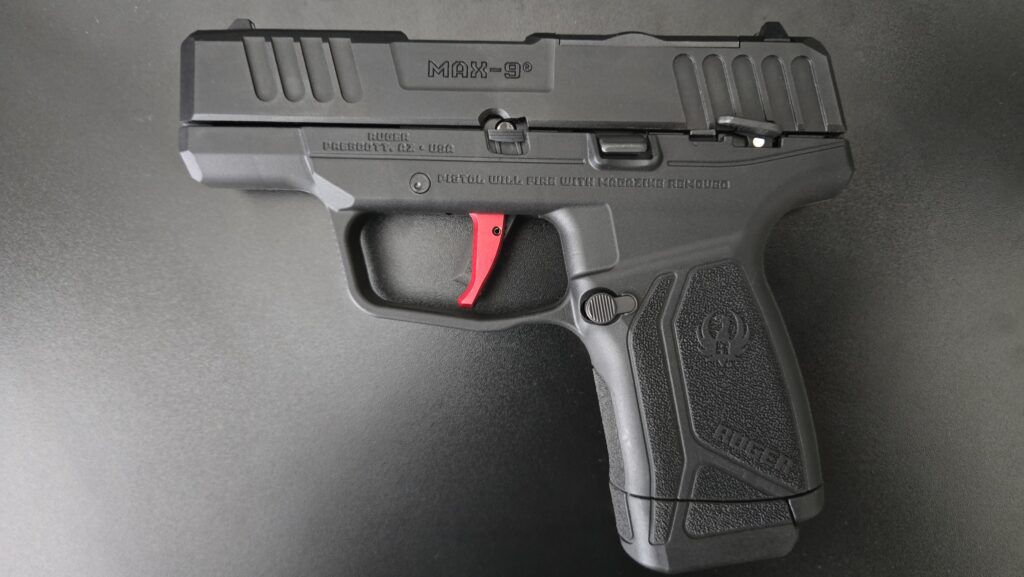
I went with red, which normally wouldn’t have been my first color choice. However, on this particular gun, I like it quite well. It adds just enough contrast without looking completely out of place, and I think it gives the MAX-9 a little more personality.
More importantly, it feels good and shoots well.
After installing it and putting rounds through the gun, the original sticking-safety problem appears to be gone for good.
From that standpoint, the Galloway accomplished exactly what I bought it to accomplish.
There are, however, a few design decisions that leave me scratching my head.
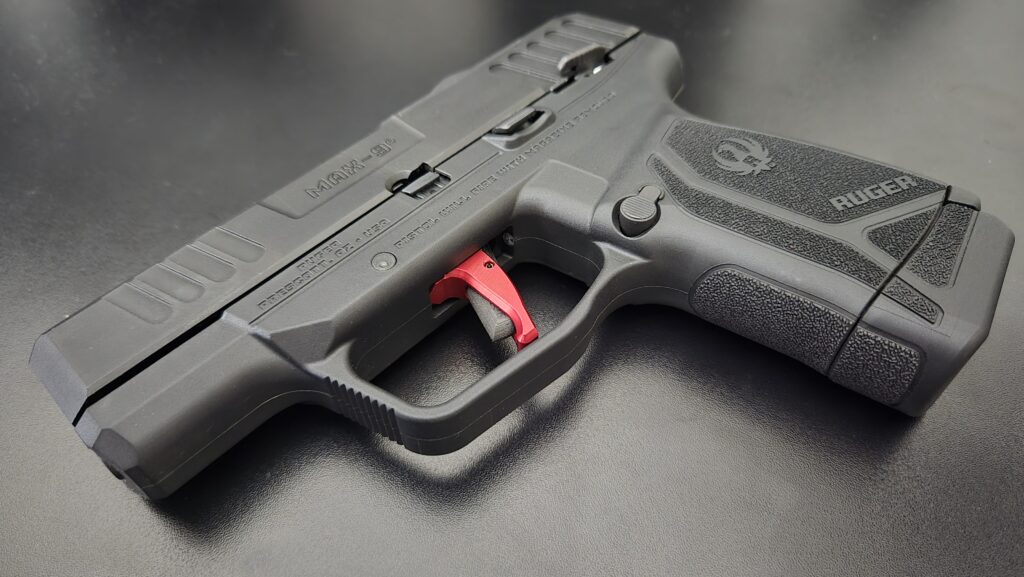
The 3D-Printed Trigger Safety
My first complaint is something Galloway doesn’t hide – they are very clear in the item description that the trigger safety itself is 3D printed.
I knew this before ordering it. It’s stated in the product information, so this wasn’t a surprise.
Still, knowing something from a product listing and actually seeing it in person are two different things.
When I first opened the package and looked at the safety, I was a little skeptical and honestly somewhat disappointed. The main trigger component looks and feels like a quality piece, which makes the printed safety stand out even more.
I can’t help but wonder why the safety couldn’t have been machined from material that better matches the rest of the trigger.
I understand that manufacturing decisions involve cost, complexity and production volume. A machined safety would almost certainly increase the price.
Personally, I would have been willing to pay the difference.
For a component that’s part of the trigger assembly, I’d rather see the entire product give the same impression of durability and quality.
To be clear, that doesn’t mean the printed safety has failed. It hasn’t. It works exactly as it should.
After shooting the gun, I haven’t seen anything that currently gives me reason to believe the safety is inferior, or would ever stop functioning. My criticism is more about the design and construction choice than an actual failure I’ve experienced.
Time will ultimately tell how well it holds up. I expect it to do just fine.
One Part of the Geometry Doesn’t Make Sense to Me
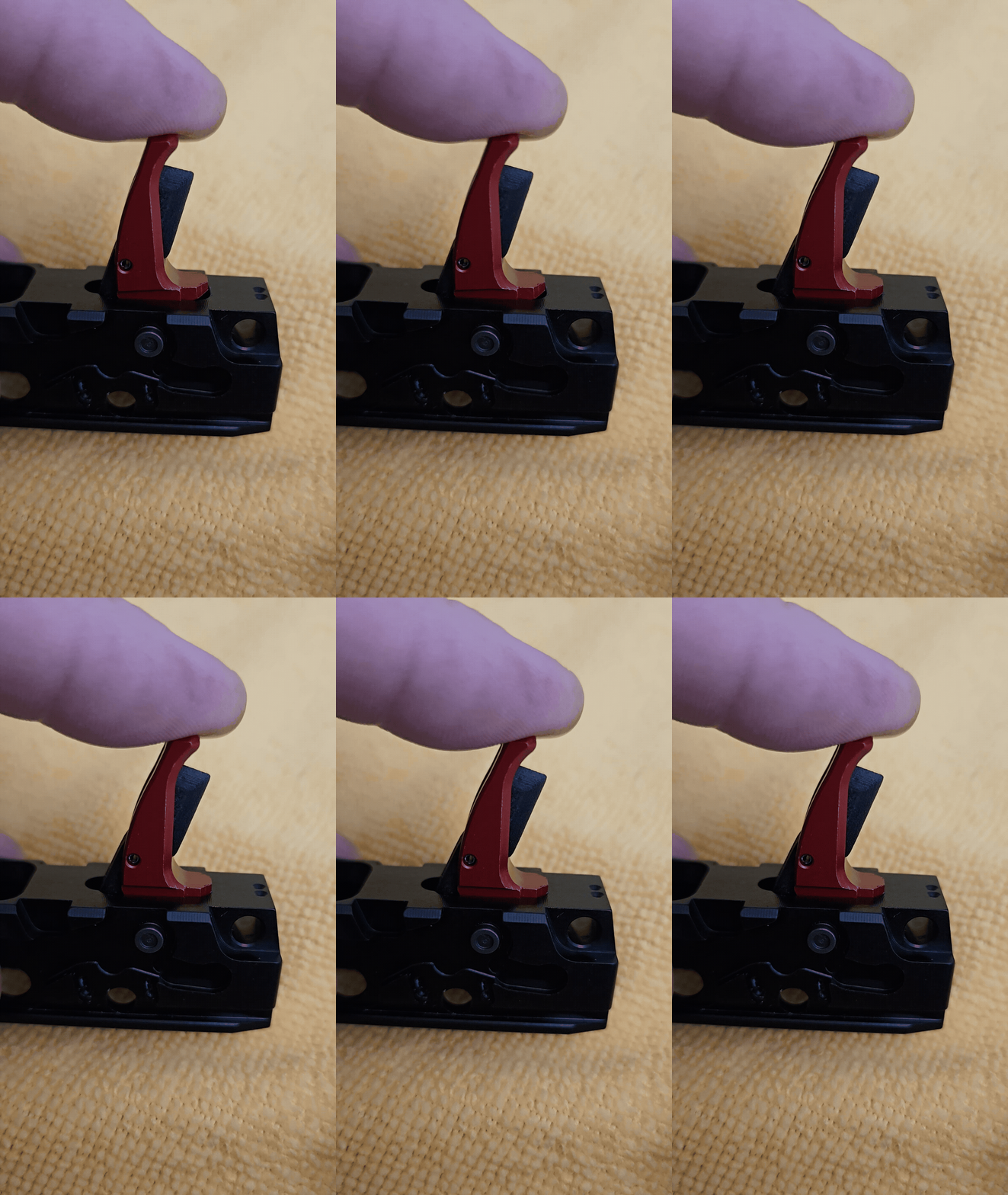
This is probably my biggest question about the Galloway design, and unfortunately it’s also the hardest part to describe without seeing it.
The front edge of the trigger stop doesn’t completely clear the opening in the trigger housing.
We’re talking about a very small amount of interference, less than a millimeter from what I can say without pulling out a caliper to measure. But the edge appears to make contact with the front of the opening.
What’s interesting is that I don’t think this is accidental. I think it may be an intentional part of the design.
If that portion of the trigger completely cleared the opening, it appears the trigger would potentially have considerably more take-up.
That makes me wonder whether the geometry is intentionally using that point to limit movement.
I don’t know.
And that’s an important distinction.
I’m not claiming that Galloway engineered it incorrectly because I don’t know what their design intent was. It could be intentional. It could be a tolerance issue. It could be something particular to my gun or trigger. There may also be something about the mechanism I’m simply not accounting for.
What I can say is that I can see the contact point.
That makes me wonder what happens after hundreds or thousands of cycles.
Does it simply polish itself into a stable contact surface?
Does it wear enough to change the trigger movement?
Does nothing meaningful happen at all?
At this point, I don’t have enough rounds through it to answer those questions.
It’s something I’m going to keep an eye on.
Removing the Factory Trigger Creates Another Problem
There’s also something worth knowing before taking the factory trigger apart.
Once you remove it, putting the original assembly back together may be considerably more frustrating than taking it apart.
There’s a tiny spring associated with the factory trigger safety that must be removed to remove the trigger. After taking it apart I still haven’t figured out a reasonable way to reinstall it correctly.
Maybe there’s a trick to it.
If there is, I haven’t discovered it yet.
That’s worth considering if you’re replacing the trigger but want the ability to return the gun completely to its original configuration later.
I wouldn’t assume that removing the factory trigger means you’ll be able to casually throw it back together in five minutes.
Why I Chose the Galloway Maxxis Instead of MCARBO for my Max-9
The MCARBO trigger was the other option I seriously considered.
In fact, I came very close to buying it instead.
What ultimately pushed me toward Galloway was the adjustable take-up system on the MCARBO design.
The adjustment uses a small Allen screw.
I understand the appeal. Being able to adjust trigger take-up sounds like a feature, and plenty of people may prefer having that control.
For me, though, it introduces another variable into a component where I don’t particularly want additional variables.
Any threaded adjustment potentially creates another point that can move. Yes, thread locker can be used. And yes, properly installed fasteners can remain exactly where they’re supposed to be.
But I personally don’t want to depend on that if I don’t have to.
I’d rather the geometry of the trigger establish the appropriate movement without an adjustment screw.
That’s not to say the MCARBO trigger is unsafe or that its adjustment screw will come loose. I haven’t installed and tested one, so I can’t make that claim.
There’s also a visual factor I don’t care for. You can slightly see the Allen screw on the trigger after the gun is reassembled.
It’s simply a design choice I don’t personally prefer.
That was ultimately enough to push me away from MCarbo and toward the Galloway.
There May Be an Even Simpler Solution For The Max-9 Trigger Issue
After looking closely at the factory trigger, I’m also starting to wonder whether replacing it is necessary at all.
The original problem appears relatively simple.
The edge of the factory trigger safety catches against the edge of the slot in the trigger. Both surfaces have sharply defined edges, and those edges appear to catch each other under certain conditions.
That raises an obvious question.
Could the original trigger simply be corrected?
Potentially, but this is an area where I would be cautious. Removing material from any part of a firearm’s trigger or safety mechanism can change how that mechanism functions, and what looks like an insignificant amount of material can sometimes matter more than expected.
So I’m not recommending that anyone start filing on their trigger.
What I am interested in doing eventually is examining the factory assembly more closely and determining whether the interference can be addressed while maintaining the intended operation of the safety.
If I experiment with the factory trigger in the future, I’ll treat that as a separate project and verify the operation carefully rather than assuming a modification is safe simply because it appears to solve the sticking problem.
It would be interesting if the best solution ultimately turned out to be the simplest one.
Is the Galloway Precision Maxxis Short Stroke Trigger Worth It For a Ruger Max-9?
For me, it’s a resounding yes.
Despite my criticisms, I prefer the Galloway trigger to the factory setup.
The most important reason is simple… it solved the problem I was trying to solve!
The trigger safety now operates the way I expected it to, the trigger feels good while shooting, and visually I think it’s a substantial improvement.
I also prefer the basic design philosophy over an adjustable take-up system using a small set screw, which is why I’d personally still choose the Galloway over the MCARBO based on the options I’ve researched.
That doesn’t mean I think Galloway nailed every aspect of the design.
I’d much rather see a machined safety than a 3D-printed one. I’m curious about the small contact point between the trigger stop and housing.
And the difficulty of reassembling the original trigger is something owners should probably know about before taking everything apart.
None of those issues, however, have caused the Galloway trigger to fail in my testing so far.
I’ve put enough rounds through the gun that I’m comfortable leaving it installed.
My Final Takeaway On The Galloway Maxxis
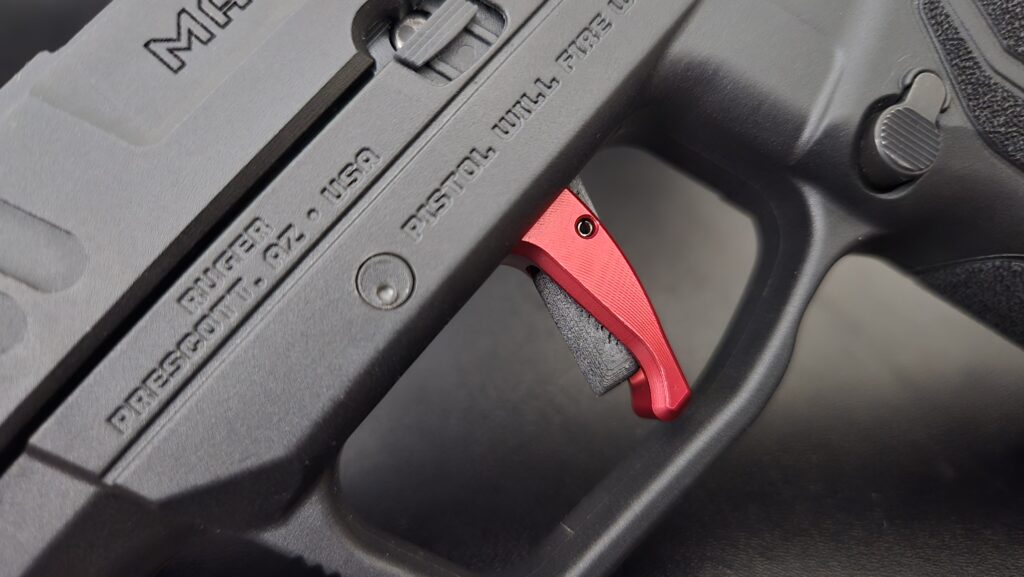
After actually installing and shooting the Galloway trigger, I’d describe it as a good solution that could have been a better product with a little more attention to a few details.
That’s different from saying it’s a bad trigger.
It isn’t.
It solved the sticking trigger-safety issue that started this entire project, it feels good, it looks great, and so far, it has functioned reliably.
I just think there’s room for improvement.
For now, the Galloway is staying in my MAX-9 for as long as it continues performing the way it does today.
I’m also keeping the factory trigger around because I haven’t completely given up on it. At some point, I’d like to take a closer look at exactly why the original safety catches and whether there’s a reasonable solution that preserves its proper function.
That experiment may end up being just as interesting as replacing the trigger in the first place.
For anyone else dealing with the same problem, this is simply my experience with my gun and the particular trigger I installed.
Your experience may be different, and anything involving a firearm’s trigger or safety system deserves considerably more caution than an ordinary cosmetic modification.
But if you’re considering the Galloway Maxxis because your MAX-9 trigger safety is giving you the same trouble mine was, I can at least say this.
It solved the problem for me.
And despite a few things I wish Galloway had done differently, I don’t regret installing it. And I will recommend as the best aftermarket trigger that I’ve found for the Ruger Max-9 so far.